
Every year, over 2.7 million workers worldwide lose their lives due to work-related accidents or diseases, according to the World Health Organization (WHO). This staggering statistic highlights the critical need for businesses to prioritize workplace safety and health.
For decades, OHSAS 18001 served as the benchmark for occupational health and safety (OHS) management systems. However, with the global work environment evolving rapidly and safety risks becoming more complex, a stronger, more integrated approach was necessary.
ISO 45001, the first ISO standard, was made not just to address compliance but also to build a proactive, risk-based culture that can prevent incidents before they happen.
With over 100,000 certifications worldwide, ISO 45001 has proven to be more than just a regulatory requirement; it’s a strategic tool for fostering safer, more resilient workplaces.
As the shift from OHSAS 18001 to ISO 45001 continues, understanding the key differences between them and the benefits of the transition is crucial. This blog will explore why ISO 45001 is not just a better standard but a vital investment in your organization’s future.
Understanding the Standards: OHSAS 18001 vs ISO 45001
OHSAS 18001
Introduced in 1999, OHSAS 18001 (Occupational Health and Safety Assessment Series) was developed to provide organizations with a structured framework for managing OHS risks.
It focused on identifying hazards, managing risks, and reducing workplace incidents by implementing effective policies and procedures. For years, it served as a widely recognized benchmark for occupational safety, helping companies reduce injuries and demonstrate compliance.
However, OHSAS 18001 was not an official ISO standard; instead, it was developed by a consortium of national standards bodies and certification organizations. Over time, inconsistencies emerged, particularly when integrating with other ISO management systems, such as ISO 9001 (quality management) and ISO 14001 (environmental management).
ISO 45001
ISO 45001, introduced in March 2018, replaced OHSAS 18001 as the first international ISO standard for OHS management systems. It was created to provide a unified global standard under the ISO framework.
It aligns with other ISO management systems for seamless integration. This has helped organizations shift focus from hazard identification to risk-based prevention and continuous improvement.
ISO 45001 aims not only to prevent workplace accidents but also to establish a proactive safety culture that protects both employees and organizations.
Why Transitioning to ISO 45001 Became Essential for Workplace Safety
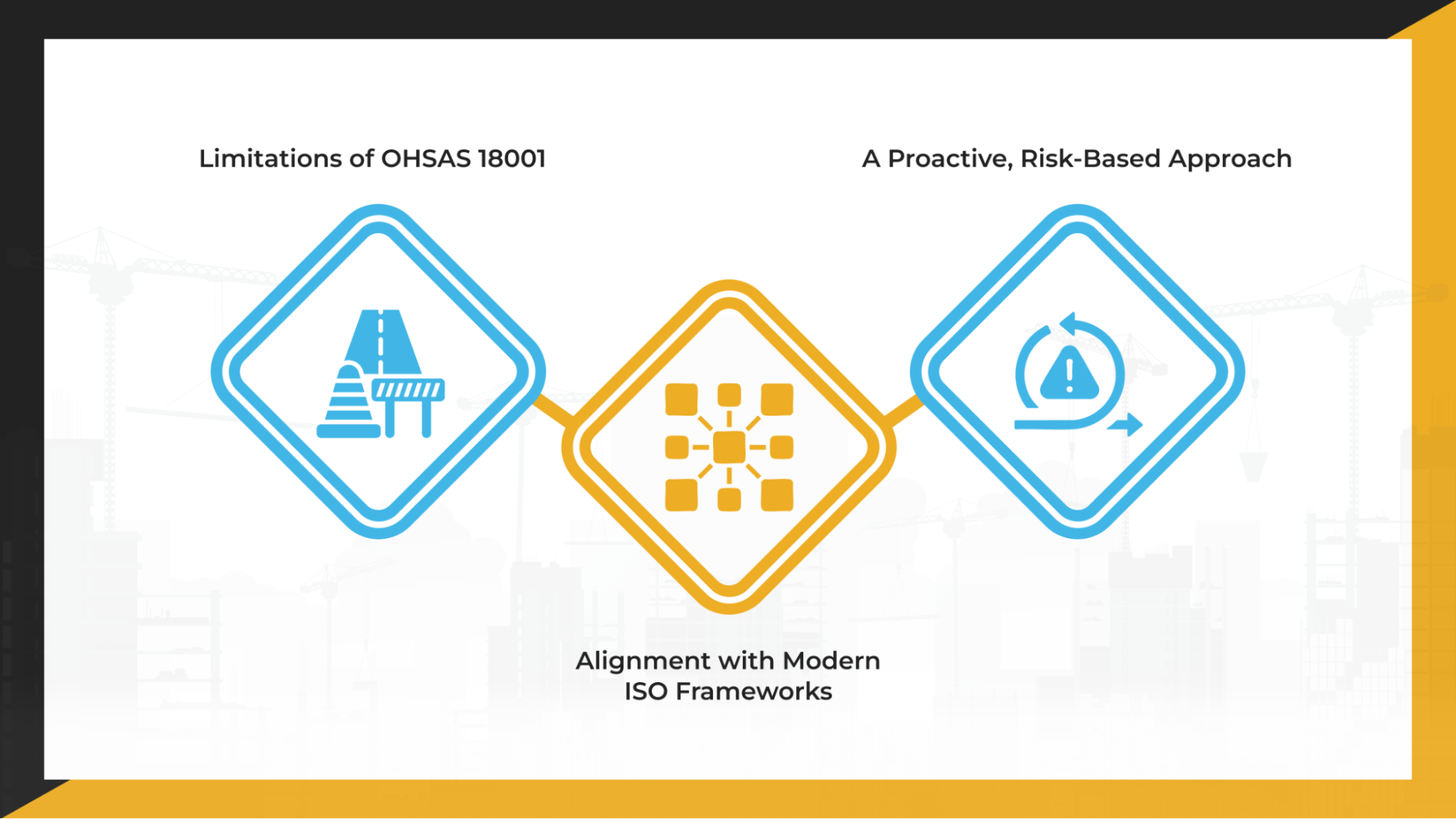
The transition from OHSAS 18001 to ISO 45001 was not merely an update; it was a strategic evolution toward modern safety thinking.
1. Limitations of OHSAS 18001
While OHSAS 18001 established a foundation for safety management, it had notable limitations. It focused on reactive hazard control rather than proactive risk prevention. Leadership accountability was limited, often confined to safety managers rather than executives.
Integration with other ISO systems (such as ISO 9001) was cumbersome due to structural differences. It lacked emphasis on organizational context and worker participation.
2. Alignment with Modern ISO Frameworks
ISO 45001 was built using the Annex SL structure, a standardized framework applied across all major ISO standards. This ensures compatibility with ISO 9001 and ISO 14001, making it easier for organizations to integrate their quality, environmental, and safety systems into a single, cohesive management model.
3. A Proactive, Risk-Based Approach
Perhaps the most significant philosophical shift is ISO 45001’s emphasis on proactive risk management rather than reactive hazard control. The goal is to anticipate potential risks before they cause harm, embedding safety into every operational decision.
How to Transition from OHSAS 18001 to ISO 45001
Below are the essential actions required to successfully migrate from OHSAS 18001 to ISO 45001, ensuring a smooth transition to a more proactive and integrated safety management system.
1. Conduct a Gap Analysis
The first step in migrating from OHSAS 18001 to ISO 45001 is performing a detailed gap analysis. This involves comparing your existing occupational health and safety management system (OHSMS) with the requirements of ISO 45001.
The purpose of this is to identify which elements of your current system already meet the new standard and where changes are needed. A thorough gap analysis enables organizations to plan their transition efficiently and allocate resources where they are most needed.
2. Engage Leadership
Leadership involvement is a key requirement under ISO 45001. Top management must demonstrate commitment to the OHSMS by integrating health and safety objectives into the organization’s overall business strategy.
This includes providing necessary resources, defining roles and responsibilities, and promoting a culture that prioritizes safety. Leadership engagement ensures that the migration is not treated as a compliance exercise but as a strategic improvement for the entire organization.
3. Redefine Context and Stakeholders
ISO 45001 requires organizations to consider both internal and external factors that can affect health and safety performance. This means analyzing business conditions, regulatory changes, supply chain influences, and stakeholder expectations.
Organizations must also identify all relevant interested parties, such as employees, contractors, regulatory bodies, and customers, and understand their needs and concerns related to OHS. This broader perspective allows for more effective and informed decision-making.
4. Update Objectives and Policies
Health and safety objectives and policies should be reviewed and aligned with the organization’s strategic direction. Under ISO 45001, goals should be measurable, achievable, and designed to drive continual improvement.
The policy should clearly reflect the organization’s commitment to preventing injury and ill health, fulfilling compliance obligations, and enhancing performance. Updating these elements ensures that the system is both relevant and goal-oriented.
5. Revise Documentation
ISO 45001 introduces the concept of “documented information,” which replaces the previous distinction between “documents” and “records.” Organizations should review and restructure their documentation to meet this requirement.
The focus should be on ensuring that information is accessible and up to date and effectively supports the management system. This may involve updating procedures, simplifying forms, and ensuring that digital systems are properly organized.
6. Employee Training and Awareness
Training and awareness are essential for a successful transition. All employees should understand the changes introduced by ISO 45001 and their specific roles in maintaining a safe workplace.
This includes training on risk-based thinking, reporting procedures, and the importance of proactive participation. Building awareness helps create a culture of shared responsibility, where safety is viewed as a collective effort rather than an individual task.
7. Internal Audit
Before applying for certification, organizations should conduct an internal audit to assess readiness. The audit assesses whether the new system complies with ISO 45001 requirements and identifies any nonconformities that require correction.
It also helps verify that procedures are working as intended and that employees are following the updated processes. Conducting a thorough internal audit ensures that the organization is well-prepared for the external certification audit.
Enhance Compliance and Safety with Safe T Professionals
At Safe T Professionals, we are dedicated to elevating safety standards through our expert consulting and staffing services. By proactively addressing and preventing safety issues and equipping your workforce with the necessary knowledge and tools, we help create a safer work environment.
Partner with Safe T Professionals to enhance your company’s safety protocols and ensure compliance with industry standards. Whether you are looking to fill safety-specific roles or need expert consultation to mitigate workplace hazards, we are here to help.
Connect with us today!