
Every construction site has a safety plan. But OSHA citations and injuries keep proving the same point: Having personal protective equipment (PPE) on paper is not the same as being PPE compliant.
In 2023, 38.5 percent of construction deaths came from falls, slips, and trips—hazards where proper PPE such as fall protection and headgear often decides whether a worker walks away or does not.
OSHA’s own enforcement data shows that PPE-related standards remain among the most frequently cited serious violations in construction, indicating many sites are missing basic compliance steps, not just rare edge cases.
That is why PPE compliance matters. OSHA does not look only for hard hats, vests, goggles, or harnesses on-site. It looks for a working system behind them.
A hazard assessment that proves you picked PPE for real risks. Proper fit for every worker. Training that workers can repeat back. Gear that is inspected and replaced before it fails. And supervisors who enforce its use every day.
This blog breaks down what OSHA PPE compliance really means for construction sites, the exact standards you must follow, where most companies get cited, and how to make your PPE program inspection-ready and worker safe.
Understanding OSHA PPE Compliance Requirements
OSHA uses PPE to mean the gear workers wear to reduce exposure to hazards that can cause injury or illness. On construction sites, this includes protection for the eyes, face, head, hands, and feet, as well as protective clothing, respiratory devices, and fall-preventing or lifesaving equipment such as harnesses and lifelines.
OSHA’s construction PPE rules list these categories directly and require them whenever site conditions or tasks create risks from mechanical, chemical, radiological, electrical, or similar hazards.
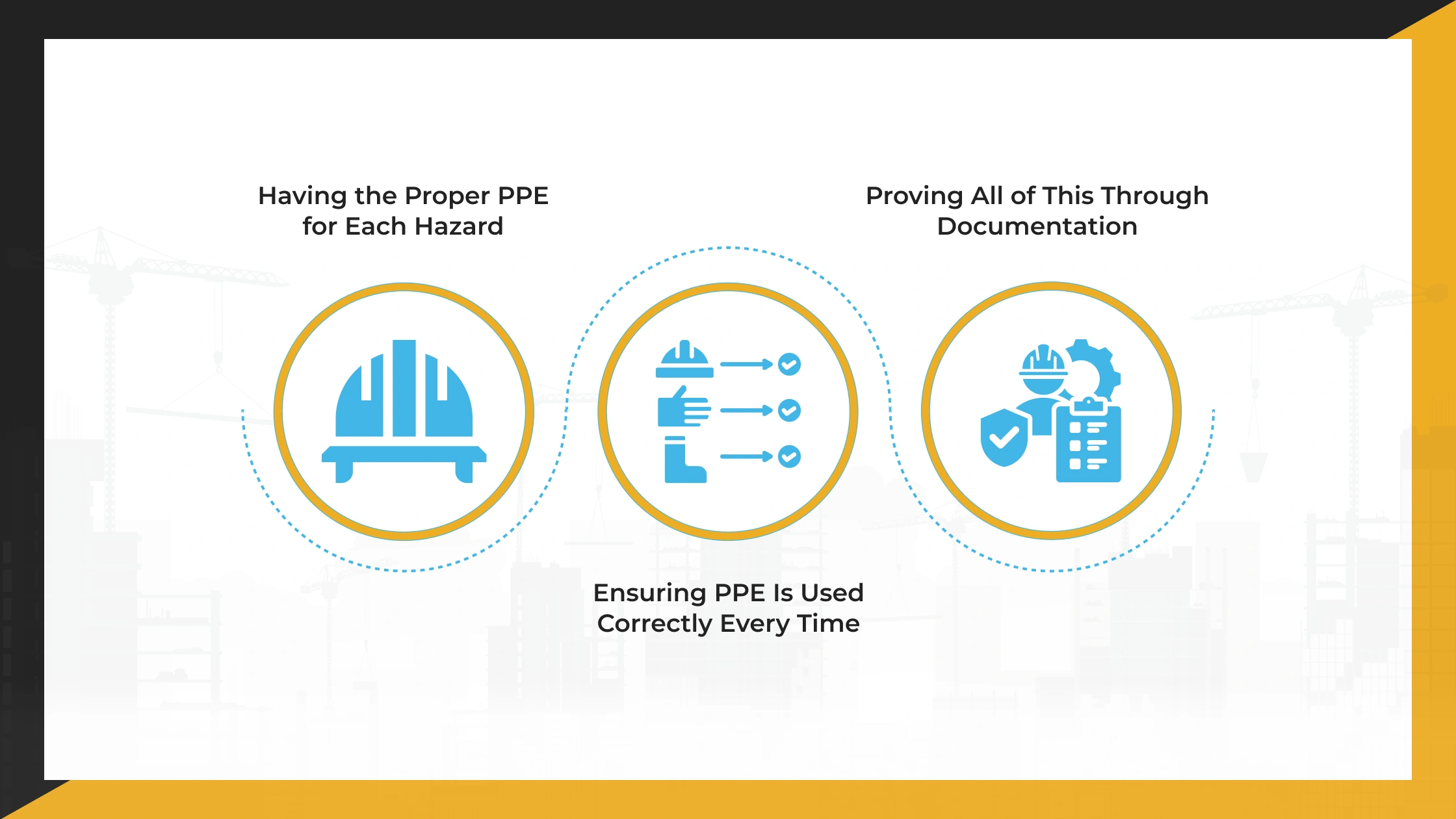
In practical terms, “PPE compliance” is not just owning PPE. OSHA expects a complete system with three parts:
1. Having the Proper PPE for Each Hazard
Employers must first look at the work being done and identify hazards that could injure workers. This is the hazard assessment requirement. Based on that assessment, employers must select PPE that is safe and appropriate for the specific task and exposure.
In construction, PPE must also properly fit each worker. As of January 13, 2025, OSHA made it an explicit construction requirement, so gear that is too large, too small, or unstable on the body is not compliant.
2. Ensuring PPE Is Used Correctly Every Time
OSHA requires employers to provide PPE and ensure workers use it whenever hazards make it necessary. Workers must know when PPE is needed, which type to use, how to wear it, and its limitations. OSHA requires training on these exact points before workers do the job, as well as retraining if they do not use PPE correctly.
PPE must also be kept in a sanitary and reliable condition. Damaged or worn-out gear cannot stay in service.
3. Proving All of This Through Documentation
OSHA inspections focus heavily on records because records show that PPE use is planned and enforced, not left to chance. At a minimum, OSHA expects evidence of:
- A written hazard assessment showing what hazards were found and what PPE is required.
- PPE selection decisions that are tied to those hazards, including fit and whether the PPE meets relevant consensus standards.
- Training records showing workers were trained on use, limits, care, and when PPE is required.
- Inspection and maintenance logs for items such as fall protection and respirators, where failure can be catastrophic.
OSHA PPE compliance means identifying hazards, choosing PPE that fits and matches those hazards, training people to use it correctly, enforcing its use on site, and keeping clear records to show it is all being done. That whole chain is what keeps a site “up to code,” not just the presence of PPE.
OSHA Construction PPE Rules Every Employer Should Know
OSHA’s construction PPE requirements sit in 29 CFR 1926 Subpart E, called “Personal Protective and Life Saving Equipment.” This subpart explains which PPE must be used on construction sites.
It sets the expectation that PPE is required whenever job hazards can cause injury through impact, chemicals, dust, fumes, electricity, or similar risks. It also stresses that PPE must be provided, used, and kept in a sanitary and reliable condition. Here are the sections within Subpart E and what they mean on a real job site:
Employer Responsibility to Require PPE
1926.28: This is the rule that makes PPE enforcement a management duty. If a task exposes workers to hazards, the employer must require the proper PPE. In practice, this means supervisors have to enforce PPE use actively, not just provide gear and hope people wear it.
Criteria for PPE
1926.95: PPE must be appropriate for the hazard, safe for the work being done, and maintained properly. Even if workers bring their own PPE, the employer is still responsible for making sure it is adequate and well maintained. This is where OSHA checks whether your PPE choices actually match the hazards you face.
Head Protection
1926.100: This section requires hard hats where there is risk of falling or flying objects, bumps, or electrical exposure. On-site, it applies to tasks such as overhead work, crane zones, demolition, formwork, and areas with exposed electrical hazards.
Hearing Protection
1926.101: This section requires protection where noise levels can damage hearing. In day-to-day terms, if workers are around jackhammers, saws, heavy equipment, or sustained high noise, hearing PPE is required and should be part of your daily PPE check.
Eye and Face Protection
1926.102: This section requires safety glasses, goggles, or face shields where there is risk from flying debris, dust, chemical splashes, or radiant energy such as welding. This is one of the most common citation areas because eye hazards are present on many tasks.
Respiratory Protection
1926.103: This section requires respirators for airborne hazards such as silica dust, fumes, asbestos, lead, or chemical vapors. It points employers to the detailed respiratory program requirements in 1910.134, so fit testing and medical evaluation still apply in construction.
Fall and Life-Saving Equipment
1926.104-1926.106: These sections cover body harnesses, lifelines, lanyards, safety nets, and work over or near water. They require proper use, inspection, and removal from service if PPE is damaged. On-site, they apply whenever workers are exposed to fall risks or drowning risks and are not fully protected by guardrails or other controls.
Employer Responsibilities for OSHA PPE Compliance
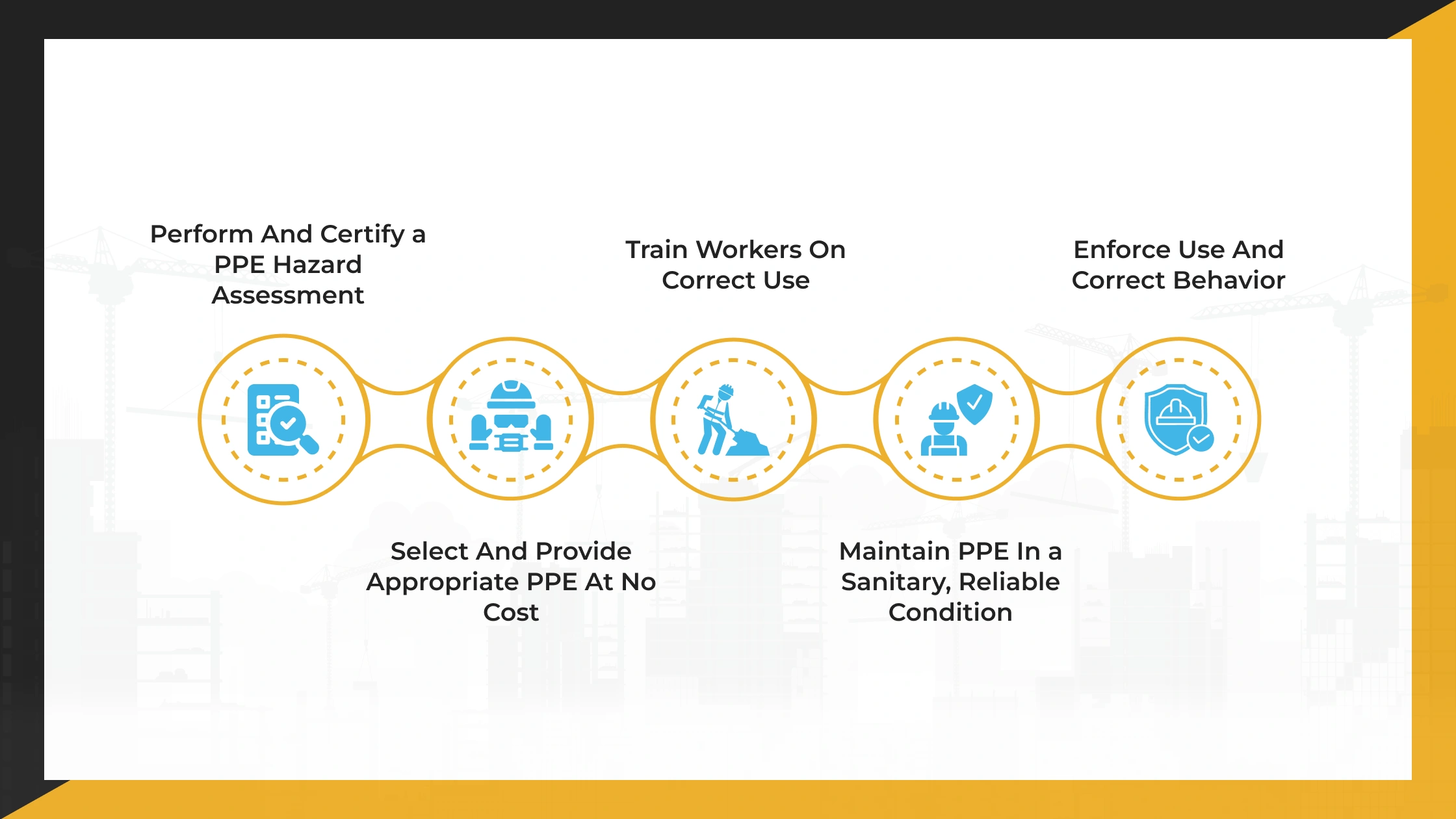
Here is what every employer needs to know to fulfill their OSHA PPE compliance requirements and maintain a safe, legal, and well-documented construction site.
1. Perform and Certify a PPE Hazard Assessment
Before choosing any PPE, employers are required to assess the work and identify actual hazards. This assessment should cover each task on site, the tools and materials used, and the exposure level workers face.
You cannot pick the right PPE until you know what could hurt someone. OSHA ties this requirement to 1910.132(d), and construction employers use it to meet their Subpart E duties.
OSHA also requires the assessment to be certified in writing. The certification is proof that the evaluation happened and that PPE decisions were not guesswork. At a minimum, the document should list the workplace or project area evaluated, the tasks reviewed, the hazards found, and the date and name of the person who completed the assessment.
To document it clearly, keep it practical and job based.
|
2. Select and Provide Appropriate PPE at No Cost
Once hazards are identified, OSHA places the next duty on the employer: Choose PPE that fits the danger and provide it to workers. If an OSHA standard requires PPE, the employer must supply it and pay for it, with only limited exceptions.
The “no cost” rule matters because it removes barriers to use. If workers have to buy their own required PPE, compliance breaks down, and OSHA treats that as an employer failure. Even when employees are allowed to use their own PPE, the employer must ensure it is adequate for the hazard.
3. Train Workers on Correct Use
OSHA requires employers to train workers before they do any job that requires PPE. The training has to be specific and usable, not general. Workers must learn when PPE is needed, which type to use, how to put it on and take it off correctly, how it should fit, its limitations, and how to care for and dispose of it.
Training is not a one-time event. OSHA says retraining is required whenever there are new hazards, new PPE, changes in work conditions, or clear signs that workers are not using PPE correctly. If a worker cannot demonstrate they understand the PPE rules or use the gear properly, the employer must retrain them before they continue the task.
4. Maintain PPE In a Sanitary, Reliable Condition
Providing PPE is not enough if it is damaged or dirty. OSHA requires PPE to be maintained so it stays protective. On-site, that means checking gear before use, cleaning or sanitizing it when needed, storing it so it does not break down, and removing it from service if it is worn out or defective. 1926.95(a) sets this expectation for construction PPE.
This applies strongly to high-risk PPE, such as respirators and fall protection. If straps are frayed, seals are damaged, or hardware is bent, the PPE is no longer reliable and cannot be used. Keeping simple inspection and replacement logs makes enforcement easier.
5. Enforce Use And Correct Behavior
OSHA treats enforcement as part of compliance. Employers must not only require PPE, but also make sure it is worn when needed. 1926.28 makes this clear by placing responsibility on the employer to require PPE use in hazardous conditions.
In practice, enforcement means supervisors correct PPE issues on the spot, repeat training when needed, and use a fair discipline process for repeated noncompliance. Many PPE citations occur because PPE rules exist on paper but are inconsistently enforced across crews or shifts. Strong daily enforcement closes that gap.
Worker Obligations for PPE Use and Compliance on Construction Sites
Workers also have clear duties under OSHA’s PPE system. Compliance only works when workers follow the rules they were trained on. Here is what every worker must do to ensure they follow proper PPE protocols and contribute to a safe, compliant jobsite.
1. Use PPE as Trained and Required
Workers must wear the PPE specified for the task and use it correctly. If a hazard assessment indicates eye protection is required, OSHA expects workers to keep it on for the entire exposure period, not just part of the job.
2. Report Damaged or Ill-Fitting PPE Immediately
If PPE is cracked, torn, or does not stay in place, workers should report it and stop using it. Poor fit now counts as noncompliant PPE in construction, so reporting fit issues is part of staying safe and legal.
3. Do Not Modify PPE Without Approval
PPE should not be altered to feel more comfortable or to “work better.” Changes like drilling holes in hard hats, cutting the fingers of gloves, or tying off harness straps can reduce protection. OSHA expects PPE to be used as designed and trained.
4. Participate in Fit Testing and Medical Clearance
When respirators are needed, workers must complete medical evaluations and fit tests, then wear the respirator exactly as tested. If they skip these steps or wear a respirator incorrectly, protection fails, and the site falls out of compliance.
Eliminate Safety Gaps & Stay Ahead of Compliance with Safe T Professionals

At Safe T Professionals, we are dedicated to elevating safety standards through our expert consulting and staffing services. By proactively addressing and preventing safety issues and equipping your workforce with the necessary knowledge and tools, we help create a safer work environment.
Partner with Safe T Professionals to enhance your company’s safety protocols and ensure compliance with industry standards. Whether you are looking to fill safety-specific roles or need expert consultation to mitigate workplace hazards, we are here to help.
Connect with us today!