
A technician is working on a live power panel while a contractor is running cable up in the ceiling.
One wrong move could mean an electric shock, a fall, or an outage that takes critical systems offline. You may have safety policies in place, but what really matters in the moment is whether people know what to do and follow the procedure.
That’s what data center safety is about: protecting people and uptime in a place full of high-voltage equipment, tight spaces, heavy gear, and multiple trades working side by side.
A basic safety program designed for a general workplace isn’t enough here. Data centers need controls that match their real risks: arc flash, complex lockout/tagout (LOTO), hot aisles, tricky access routes, and constant contractor activity.
This blog walks you through how to build and strengthen a site-specific data center safety program: clarifying what “good” means for electrical work, elevated access, chemical and fire hazards, contractor management, emergency readiness, and ongoing verification.
The Fundamentals of Effective Data Center Safety
Data center safety isn’t just a scaled-down version of construction or industrial safety. It’s a specialized practice built to match the operational intensity of facilities that never stop running.
At its core, a data center safety program aims to prevent injuries, reduce incident risk, and maintain regulatory compliance by combining engineering controls, safe behaviors, and procedural rigor.
Environments might look tidy, but there are always hidden hazards, including:
- Serious arc flash and shock potential from high-energy panels
- Elevated work exposure in ceiling plenums and raised floors
- Repetitive motion concerns during server and cable handling
- Heat stress from confined, climate-sensitive spaces
- Trips and slips caused by dense equipment layouts and tool storage
- Blocked or narrow emergency access routes
- Frequent use of cranes, lifts, or hoisting gear during active build-outs
A safe data center doesn’t just rely on individual caution; it’s designed for safety. That includes engineering out known hazards, setting clear behavioral expectations, embedding real-world training, and documenting compliance across every risk category.
Why Data Centers Need Purpose-Built Safety Programs
Applying generalized safety practices in these environments is like using a basic first-aid kit in a trauma center: It’s not enough.
Data center teams work in unique, fast-moving conditions with layered hazards. They’re expected to achieve zero-failure uptime targets while often relying on high-voltage systems, complex mechanical components, specialized vendors, and narrow workspaces. In this kind of environment, broad-brush safety rules won’t prevent injuries or citations.
For example, you may have a LOTO policy, but unless a technician knows the exact de-energization points for a particular UPS system and is trained to identify where stored energy lingers, LOTO won’t hold up in the field. Similarly, if your HVAC contractor is working in the plenum without enforced fall restraint, your site is one slip away from a recordable injury and potential OSHA fine.
Each trade involved in your facility, from network engineers and electricians to battery vendors and mechanical contractors, faces different risks. Training must be just as specific.
And then there’s uptime. A single safety failure won’t just threaten life and limb. It can cause data loss, system outages, or client SLA violations, all of which can cost millions.
Your safety program must be as specialized and fail-safe as your technical infrastructure. That means aligning controls, communications, and training to the specific tasks and exposures at your site.
Fundamental Safety Components of a Data Center Program
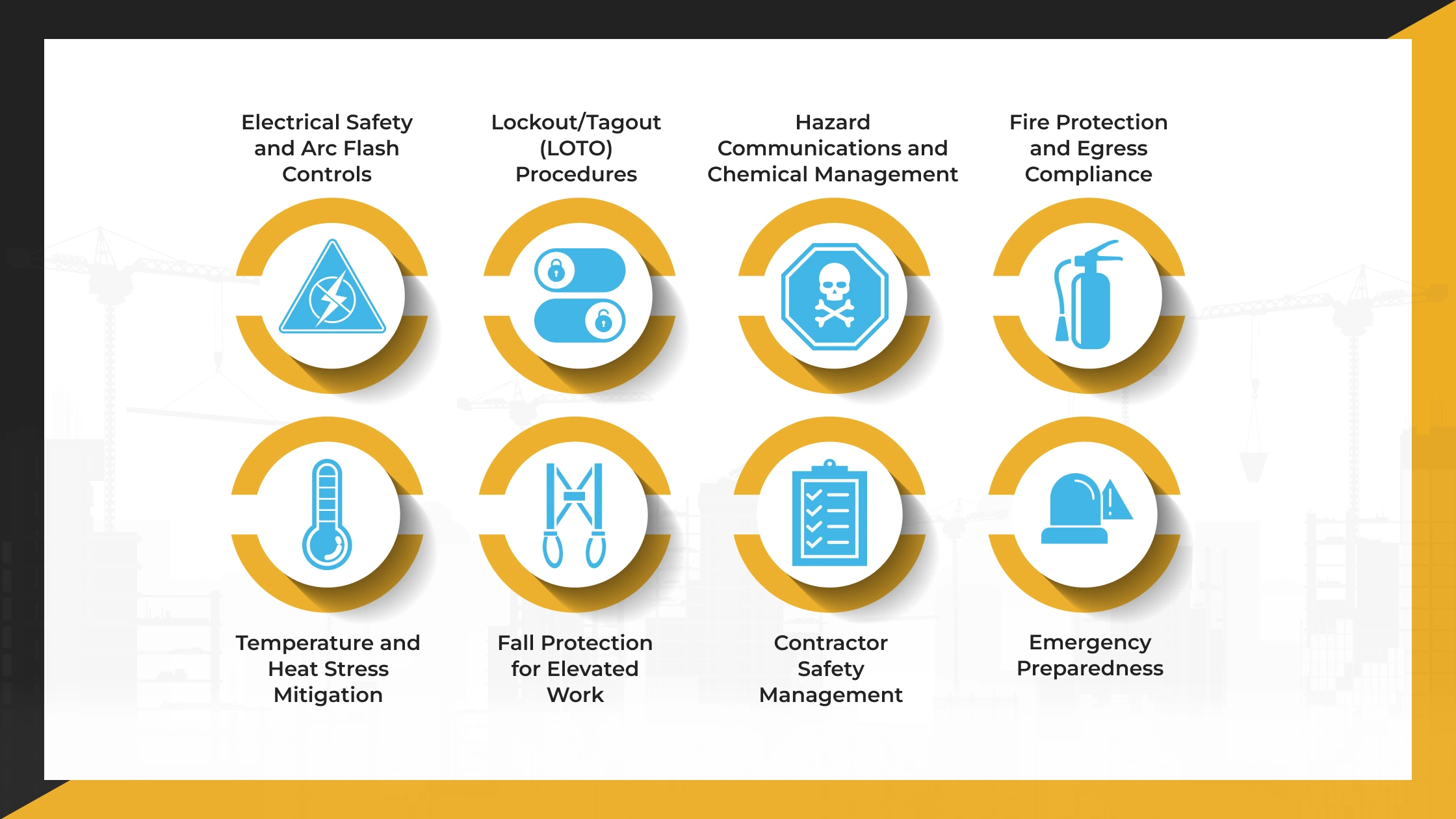
To meet regulatory requirements and protect your operations, a data center safety program must include these fundamental elements:
-
Electrical Safety and Arc Flash Controls
High-density power means arc flash hazards are everywhere. NFPA 70E compliance isn’t optional. Every technician must be trained, assessed, and adequately equipped for energized work, including qualified worker designation, arc-rated PPE, panel labeling, and shock boundary awareness.
-
LOTO Procedures
Effective LOTO is about consistent execution rather than policy. You need equipment-specific procedures, accessible documentation, and job roles trained to verify isolation before any work begins.
-
Hazard Communications and Chemical Management
Chemical use is often overlooked in tech settings. Manage battery systems, refrigerants, and cleaning agents in full compliance with the OSHA’s HazCom Standard. Keep Safety Data Sheets visible and conduct regular spill response drills.
-
Fire Protection and Egress Compliance
Automatic suppression systems are standard, but not foolproof. Train all personnel on the impact of clean-agent systems, such as FM-200, and maintain clear egress paths, even during upgrades or cabling projects.
-
Temperature and Heat Stress Mitigation
Server environments can reach extreme temperatures, especially during maintenance or shutdowns. Provide cooling periods, hydrate stations, and scheduled rest times for technicians working in hot zones.
-
Fall Protection for Elevated Work
Ceiling and mezzanine access is often required and frequently unsafe. Use portable anchor systems, guardrails, or fall restraint equipment, and don’t rely on ladders alone. Preplan access and verify protection is in place before any work begins.
-
Contractor Safety Management
Growth fuels complexity. As you onboard third-party integrators, construction teams, or mechanical vendors, ensure they meet your standards. Use prequalification programs, mandatory orientations, and field supervision to protect your core safety culture.
-
Emergency Preparedness
Emergencies look different in data centers. Fire response, toxic gas discharge, electrical faults, and heat illness require tailored readiness. Install AEDs, prepare spill kits, run evacuation drills, and update procedures as the facility evolves.
How to Build a Site-Specific Data Center Safety Program
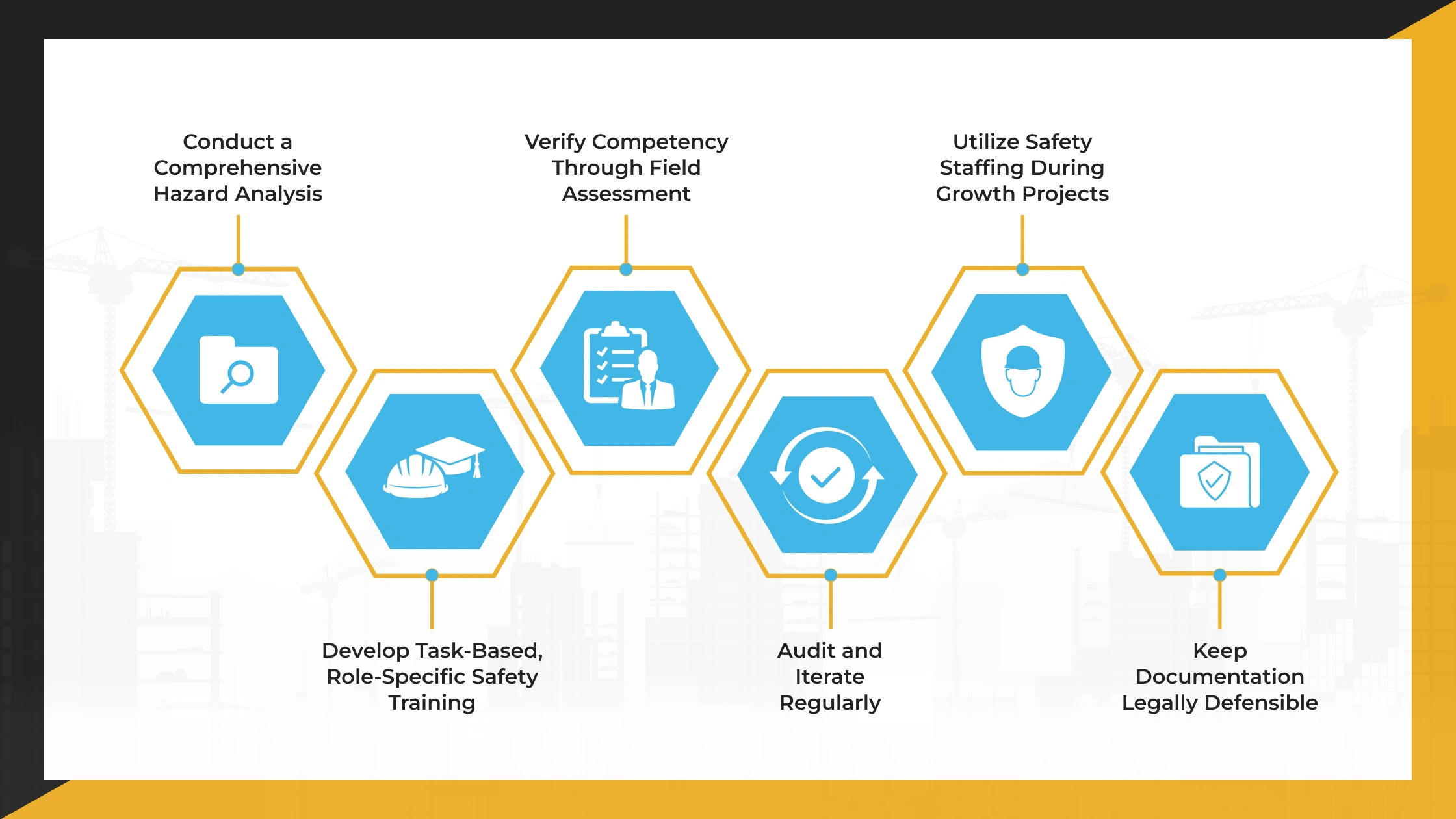
You can’t build comprehensive safety overnight. But with steady planning, you can move from generic compliance paperwork to a high-trust, high-performance safety ecosystem. Here’s how to build or level up your data center safety program:
-
Conduct a Comprehensive Hazard Analysis
Begin by mapping out the real work that happens in your data center, not just the equipment you own. Use Job Safety Analyses (JSAs) for every critical role and task, including electrical work, HVAC service, IT maintenance, battery handling, and construction activities.
For each task, identify where incidents may most likely occur by examining complete workflows, handoffs between teams, and all energy sources (electrical, mechanical, thermal, stored). The goal is to understand how work happens on the floor so your controls target real risks instead of theoretical ones.
-
Develop Task-Based, Role-Specific Safety Training
Once JSAs are in place, convert them into practical training content for specific roles, such as electricians, network technicians, HVAC mechanics, and facilities staff. Focus on the hazards they encounter, the controls they must use, and the steps they must follow for safe execution.
Include short knowledge checks, scenario-based discussions, and field demonstrations so training feels relevant and connects to their daily work.
-
Verify Competency Through Field Assessment
Don’t assume that someone is qualified just because they completed an online module or signed a training roster. Require field supervisors or safety leads to observe and sign off on workers performing high-risk tasks, such as LOTO on critical equipment, work in energized panels, or elevated work in plenums and mezzanines.
Use structured checklists for core competencies and restrict access to specific tasks until workers have demonstrated they can perform them safely. This closes the gap between “trained” and “competent.”
-
Audit and Iterate Regularly
Treat your safety program as a living system. Conduct internal audits at least twice a year, and supplement them with targeted mock inspections that mirror what a regulator or client might review.
Look for gaps between written procedures and real practice, missing labels, blocked egress, inconsistent LOTO, incomplete JSAs, or insufficient contractor oversight. When you find issues, update procedures, retrain where necessary, and document the changes so you can trace improvements over time.
-
Utilize Safety Staffing During Growth Projects
Growth projects, such as new builds, retrofits, and significant system upgrades, introduce new risks, new contractors, and unfamiliar workflows. Bring in dedicated safety staffing or temporary safety leadership during these periods to manage surge activity.
These professionals can oversee commissioning work, enforce standards across multiple vendors, lead pretask planning, and ensure that safety expectations are understood and followed in the field, not just listed in the contract.
-
Keep Documentation Legally Defensible
Strong documentation is your proof that you actively manage safety, not just promise it. Maintain organized records of training and retraining, competency signoffs, audits and inspection findings, incident investigations, corrective actions, and JSA revisions.
Make sure documents include the date, are accurate, and easy to retrieve. If the OSHA, a client, or an insurer reviews your program, this paper trail should clearly show that you identify risks, act on them, and verify that controls are working over time.
Partner with Safe T Professionals for Workplace Safety Excellence

At Safe T Professionals, we’re dedicated to elevating safety standards through our expert consulting and staffing services. By proactively addressing and preventing safety issues and equipping your workforce with the necessary knowledge and tools, we help create a safer work environment.
Partner with Safe T Professionals to enhance your company’s safety protocols and ensure compliance with industry standards. Whether you’re looking to fill safety-specific roles or need expert consultation to mitigate workplace hazards, we’re here to help.
Connect with us today!